
Keywords
Vulnerable populations
Mexico
Risk factors
Allergic asthma
Chronic obstructive pulmonary disease
Public health
Ozone
How to Cite
Abstract
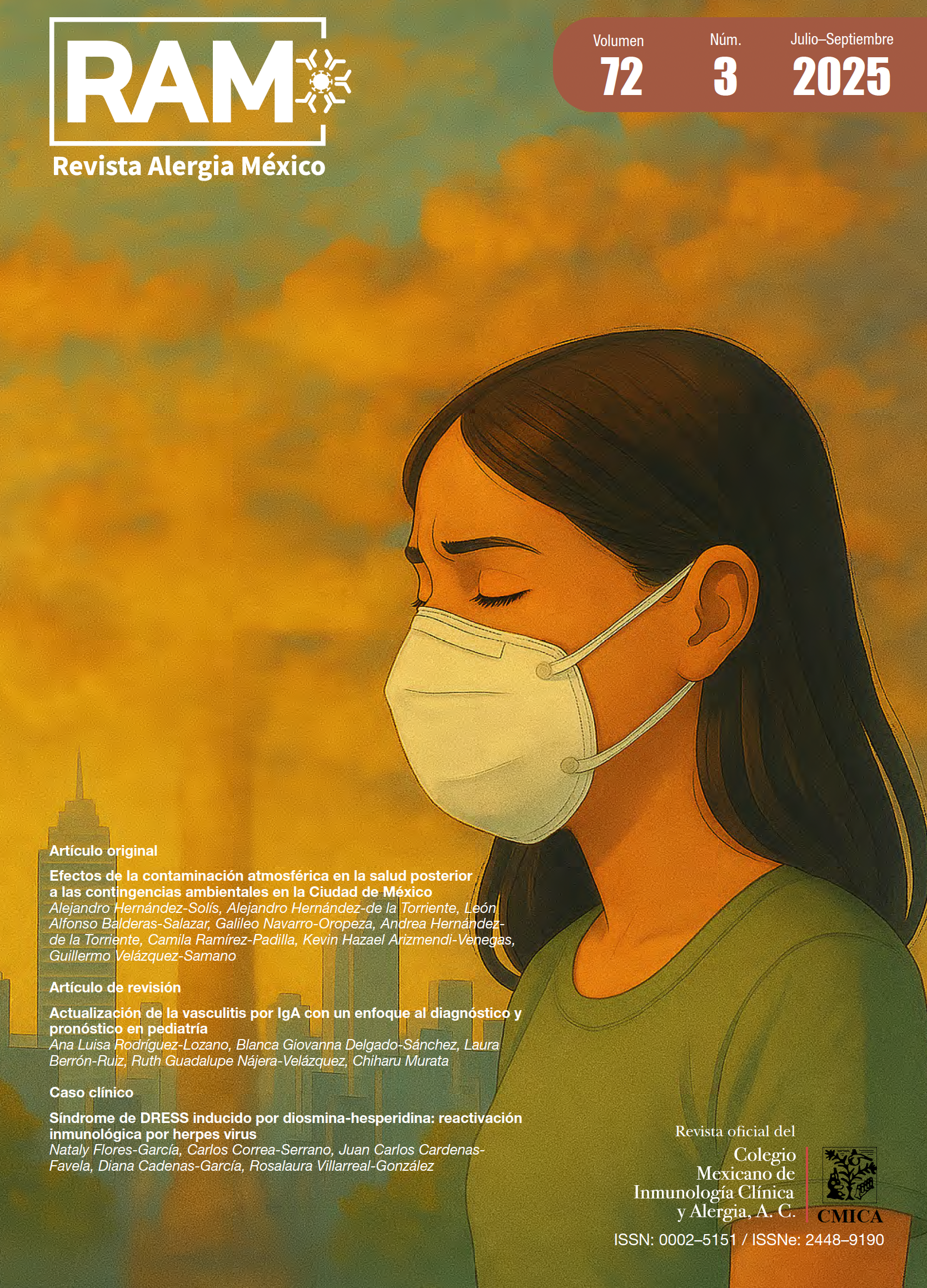
Objective: To analyze the effects of air pollution on the health of a vulnerable population in the Mexico City after the nine environmental contingencies presented in the year 2024.
Methods: A cross-sectional, descriptive study was conducted among outdoor workers (street vendors). Risk factors and respiratory symptoms were documented, and respiratory function tests were performed.
Results: A total of 300 patients were enrolled. The most frequent clinical symptoms were increased expectoration (52%), recurrent respiratory infections (44.3%), headache (39.6%), cough (35%), laryngeal irritation (34%), nasal itching (30%), dyspnea (26%), vertigo (22%), conjunctivitis (20.6%), and chest pain (19.6%). Spirometry results showed: 61.3% with a restrictive pattern, 14.3% with an obstructive pattern, 13.3% with a mixed pattern, and 11% with no abnormalities. Forty-four percent of this group experienced exacerbations of diseases such as asthma and chronic obstructive pulmonary disease.
Conclusions: Air pollution constitutes a serious public health problem, especially for low-income people, who live and work in areas with high levels of pollution, as evidenced in our study. Further epidemiological studies are essential to evaluate the impact of ozone and other pollutants on vulnerable groups, to implement more effective preventive measures.
Keywords: Air pollution; Vulnerable population; Mexico; Risk factors; Asthma; Chronic obstructive pulmonary disease; Public health; Ozone.
References
1. Rajagopalan S, Brook RD, Salerno PRV, et al. Air pollution exposure and cardiometabolic risk. Clinical Key. https://clinicalkey.es/#!/content/playContent/1-s2.0S2213858723003613?scrollTo=#hl0000218
2. Redaccion. Hoy No Circula: Origen, historia y por qué se instauró este programa en la CDMX. El Financiero. https://www.elfinanciero.com.mx/cdmx/2023/03/27/hoy-no-circula-
origen-historia-ypor-que-se-instauro-este-programa-en-la-
cdmx/
3. Se activa contingencia ambiental atmosférica por ozono en la Zona Metropolitana del Valle de México (ZMVM). Agencia de protección sanitaria del gobierno de la Ciudad de México. https://agepsa.cdmx.gob.mx/comunicacion/nota/se-activacontingencia-ambiental-atmosferica-por-ozono-en-la-zona-
metropolitana-del-vallede-mexico-zmvm
4. Ahogan contaminantes 7 de cada 10 días del año a la CDMX. Instituto de Recursos Mundiales (WRI). 7 de septiembre de 2023. Accedido el 7 de febrero de 2025. https://es.wri.org/noticias/ahogan-contaminantes-7-de-cada-10-dias-del-ano-la-cdmx? utm_source
5. Calidad del aire ambiente (exterior) y salud. World Health Organization (WHO). 24 de octubre de 2024. Accedido el 7 de febrero de 2025. https://www.who.int/es/newsroom/fact-sheets/detail/ambient-(outdoor)-air-quality-and-health?
utm_source
6. Bridget Hoffmann. Los efectos desiguales de la contaminación atmosférica sobre la salud y los ingresos en Ciudad de México-Ideas que Cuentan. Ideas que Cuentan. 23 de marzo de 2022. Accedido el 7 de febrero de 2025. https://blogs.iadb.org/ideas-quecuentan/es/efectos-desiguales-de-la-contaminacion-atmosferica-en-materia-de-salude-ingresos-en-ciudad-de-mexico/
7. Rojas-Lemus M, Bizarro-Nevares P, González-Villalva A, I Fortoul T. Vanadio: exposición atmosférica, efectos en la salud y normatividad en México. Rev Int Contamiancion Ambient. https://www.revistascca.unam.mx/rica/index.php/rica/article/view/54869/47389
8. Pérez-Padilla JR, Thirión-Romero I, Robles-Hernández R, Cagney J, et al. Enfermedades respiratorias en México. Análisis del estudio Global Burden of Disease 2021. Gaceta Médica de México. https://www.gacetamedicademexico.com/frame_esp.php? id=897
9. Rosario CS, Urrutia-Pereira M, Murrieta-Aguttes M, et al. Air pollution and rhinitis. Front Allergy 2024; 5: 1387525. doi: 10.3389/falgy.2024.1387525
10. García-Sanz MT, Doval-Oubiña L, González-Barcala FJ. Home hospitalization in pulmonology: Efficient management and high patient satisfaction. Arch Bronconeumol 2020; 56 (8): 479-480. https://www.clinicalkey.es/#!/content/playContent/
1-s2.0-S1579212920301282?returnurl=https://linkinghub.elsevier.com/retrieve/pii/S1579212920301282?showall=true&referrer=https://www.google.com/
11. Gao H, Li J, Ma Q, Zhang Q, Li M, Hu X. Causal Associations of Environmental Pollution and Cardiovascular Disease:
A Two-Sample Mendelian Randomization Study. Glob Heart. 2024; 19 (1): 52. doi: 10.5334/gh.1331
12. Nawsherwan, Shahzad Ali Khan, Sumaira Mubarik, Zhang Le, Fazli Akbar, Yan Wang. Tendencias epidemiológicas y efectos de la edad, el período y la cohorte sobre la carga de enfermedades cardiovasculares atribuible a la contaminación del aire ambiental en los países BRICS. Inf Cient 2024; 14 (11464). https://www.nature.com/articles/s41598-024-62295-6#citeas
13. Teng Y, Jiawei W, Jing H, Frank JJ K, Guoxing L. Exposición prolongada a múltiples contaminantes ambientales y asociación con la aparición de depresión y ansiedad. Clarivate 2023. https://www.webofscience.com/wos/woscc/full-record/WOS:000926119600002? SID=USW2EC0C60tmZAbkMFGd0uxFwdaxw
14. Zundel GC, Ryan P, Brokamp C, Yaoxian H, et al. Contaminación del aire, trastornos depresivos y de ansiedad y efectos sobre el cerebro: una revisión sistemática. Neurotoxicologia 2022; 93: 272-300. https://www.sciencedirect.com/science/article/abs/pii/S0161813X22001668?via=ihub
15. Informe del Medio Ambiente. Gobierno de México. https://apps1.semarnat.gob.mx:8443/dgeia/informe18/tema/cap5.html

This work is licensed under a Creative Commons Attribution-NonCommercial 4.0 International License.
Copyright (c) 2025 Revista Alergia México