
Keywords
Patch test
Cosmetic contact dermatitis
Allergens
Fragrances
How to Cite
Abstract
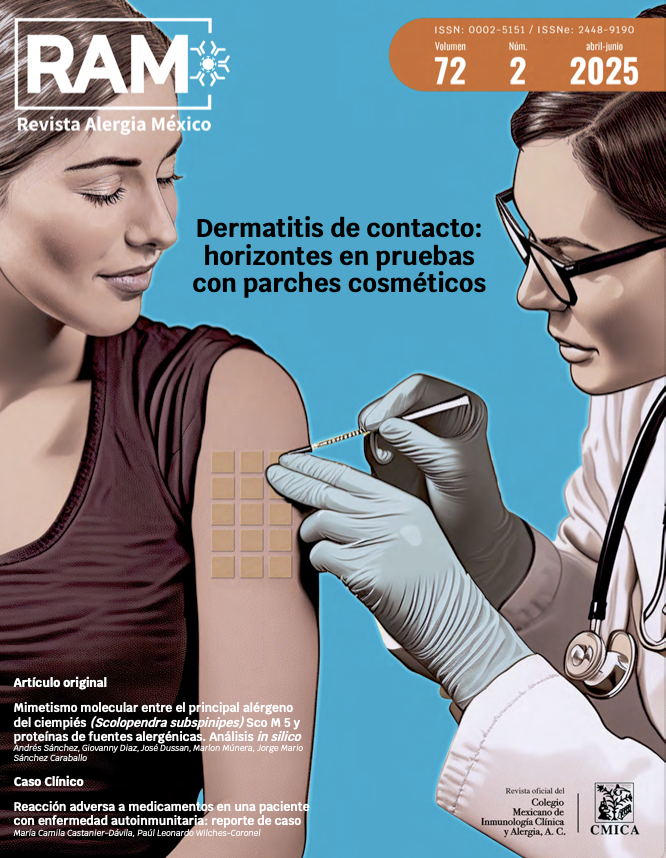
Contact dermatitis to cosmetic products is a common condition. It is likely the most frequent reason for performing patch tests because many substances used in cosmetics are potent allergens. Cosmetic contact dermatitis most frequently affects the face. Patch test series need to be continuously revised to identify outdated and emerging allergens. The aim of this study is to propose a reformulation of the patch test series for cosmetics. The list of European Surveillance System on Contact Allergies was initially used to select the allergens. Publications in PubMed from the last 10 years were sought, showing the frequency of positive reactions to cosmetic allergens that were tested as part of a baseline series or cosmetics series. Subsequently, large international databases evaluating retail products were consulted to verify if these substances were present in cosmetics, because the relevance would be their presence in commercially sold cosmetics. It was adopted a threshold of 0.3% positive patch test reactions for including a substance in cosmetics series. It was deleted those present in the baseline series (Associação Brasileira de Alergia e Imunologia), fragrances, and allergens limited to hair products. It is believed that choosing too few allergens may result in the non-identification of relevant allergens and treatable cases. On the other hand, testing a series with many allergens is time-consuming and more costly. Therefore, it seems appropriate to create cosmetics series with 20 elements.
Keyword: Contact dermatitis; Patch test; Cosmetic contact dermatitis; Allergens; Fragrances.
References
1. Horton E, Wilkinson M, Aalto‐Korte K, Pesonen M, Bauer A, Chowdhury MMU, et al. A survey of members of the European Surveillance System on Contact Allergy and the EU project “StanDerm” to identify allergens tested in cosmetic series across Europe. Cont Derm 2020; 82 (3): 195-200. doi: 10.1111/cod.13437
2. Zirwas MJ. Contact Dermatitis to Cosmetics. Clin Rev Allergy Immunol 2019; 56 (1): 119-128. doi: 10.1007/s12016-018-8717-9
3. Horton E, Uter W, Geier J, Ballmer-Weber B, et al. Developing a cosmetic series: Results from the ESSCA network, 2009-2018. Cont Derm 2021; 84 (2): 82-94. doi: 10.1111/cod.13690
4. Bruusgaard‐Mouritsen MA, Garvey LH, Johansen JD. Facial contact dermatitis caused by cosmetic‐relevant allergens. Cont Derm 2021; 85 (6): 650-659. doi: 10.1111/cod.13966
5. Qin O, Cheng Y, Hu W, Zhou H, et al. Patch test in Chinese in Shanghai with cosmetic allergy to cosmetic series and products. J Cosmet Dermatol 2020; 19 (8): 2086-2092. doi: 10.1111/jocd.13249
6. Rolls S, Owen E, Bertram CG, Bourke JF, et al. What is in? What is out? Updating the British Society for Cutaneous Allergy facial series*. Br J Dermatol 2021; 184 (1): 151-155. doi: 10.1111/bjd.19127
7. Sukakul T, Bruze M, Svedman C. Fragrance Contact Allergy – A Review Focusing on Patch Testing. Acta Derm Venereol 2024; 104 (3): adv40332. doi: 10.2340/actadv.v104.40332
8. Chemotechnique Diagnostics. Patch Test Products & Reference Manual. Published online 2024.
9. Brasil. Ministério da Saúde. Agência Nacional de Vigilância Sanitária (ANVISA). Resolução da Diretoria Colegiada – RDC No 530, de 04 de Agosto de 2021.
10. Alajaji AN. Hair Product Allergy: A Review of Epidemiology and Management. Cureus 2024; 16 (4): 1-9. doi: 10.7759/cureus.58054
11. Goossens A. Contact Dermatitis Due to Cosmetics. In: Clinical Contact Dermatitis. Springer International Publishing; 2021: 291-302. doi: 10.1007/978-3-030-49332-5_14
12. Latheef F, Wilkinson M. Adverse Skin Reactions to Cosmetics and Skin Care Products. In: Contact Dermatitis. Springer International Publishing; 2021: 913-932. doi: 10.1007/978- 3-030-36335-2_83
13. DeKoven JG, Warshaw EM, Reeder MJ, Atwater AR, et al. North American Contact Dermatitis Group Patch Test Results: 2019–2020. Dermatitis 2023; 34 (2): 90-104. doi: 10.1089/derm.2022.29017.jdk
14. Zawawi S, Yang YW, Cantwell HM, Drage LA, et al. Trends in Patch Testing With the Mayo Clinic Standard Series, 2017–2021. Dermatitis 2023; 34 (5): 405-412. doi: 10.1089/derm.2023.0063
15. Fonacier L, Noor I. Contact dermatitis and patch testing for the allergist. Ann Allergy, Asthma Immunol 2018; 120 (6): 592-598. doi: 10.1016/j.anai.2018.03.003
16. Belluco PES, Giavina-Bianchi P, Belluco RZF, Novaes MRCG, Reis CMS. Prospective study of consecutive patch testing in patients with contact dermatitis using an adapted Latin American baseline series. Eur Ann Allergy Clin Immunol 2023; 55 (05): 235. doi: 10.23822/EurAnnACI.1764-1489.250
17. Comstock JR, Reeder MJ. Accuracy of Product Ingredient Labeling: Comparing Drugstore Products With Online Databases and Online Retailers. Dermatitis 2020; 31 (2): 106-111. doi: 10.1097/DER.0000000000000553
18. Weinhammer AP, Scheman A, Reeder MJ. Prevalence of Surfactant in the Contact Allergen Management Program. Dermatitis 2019; 30 (6): 358-362. doi: 10.1097/DER.0000000000000511
19. de Groot A, Schmidt E. Essential Oils, Part V: Peppermint Oil, Lavender Oil, and Lemongrass Oil. Dermatitis 2016; 27 (6): 325-332. doi: 10.1097/DER.0000000000000218
20. Severin RK, Belsito D V. Patch Testing with Decyl and Lauryl Glucoside: How Well Does One Screen for Contact Allergic Reactions to the Other? Dermatitis 2017; 28 (6): 342-345. doi: 10.1097/DER.0000000000000327
21. Brar KK. A review of contact dermatitis. Ann Allergy Asthma Immunol 2021; 126 (1): 32-39. doi: 10.1016/j.anai.2020.10.003
22. Beene KM, Scheman A, Severson D, Reeder MJ. Prevalence of Preservatives Across All Product Types in the Contact Allergen Management Program. Dermatitis 2017; 28 (1): 81-87. doi: 10.1097/DER.0000000000000259

This work is licensed under a Creative Commons Attribution-NonCommercial 4.0 International License.
Copyright (c) 2025 Revista Alergia México